

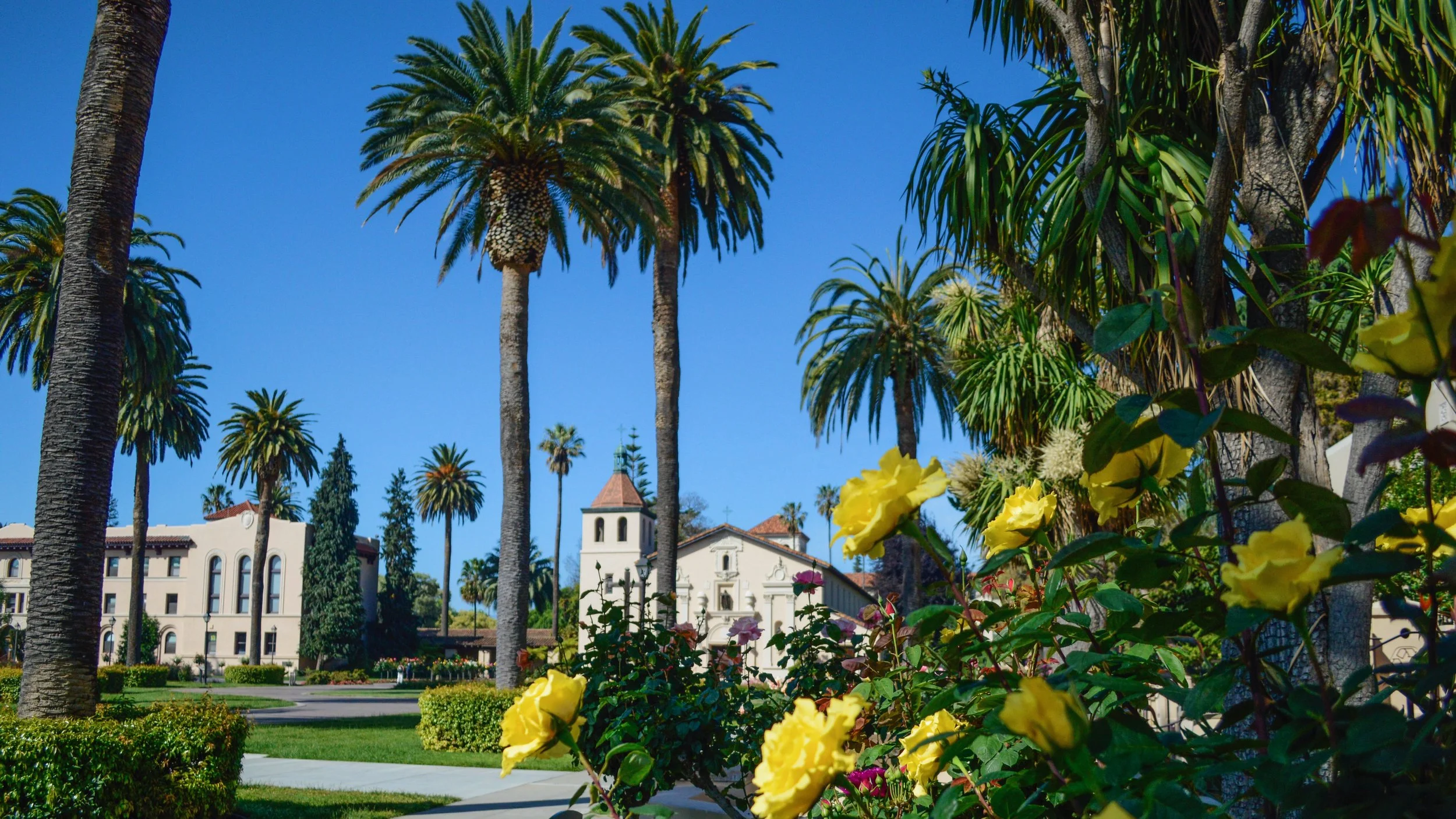
Spring 2026 At Santa Clara University
Music Recital Hall Center of Performing Arts, Santa Clara University
Saturday, March 7, 2026, 8:30am — 4:40pm
Invited Speakers
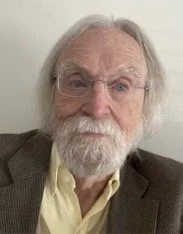
Bill Dunham, Santa Clara University
-
William Dunham (Ph.D., The Ohio State University) is a historian of mathematics who has written four books on the subject: Journey Through Genius (1990), The Mathematical Universe (1994), Euler: The Master of Us All (1999), and The Calculus Gallery (2005). He co-edited, along with Don Albers and Jerry Alexanderson, an anthology titled The G. H. Hardy Reader (2015). Dunham was the MAA’s George Pólya Lecturer from 2014 to 2016 and is featured in the Teaching Company’s DVD course, “Great Thinkers, Great Theorems.”
After his retirement as Koehler Professor of Mathematics at Muhlenberg College (emeritus, 2014), Dunham has held visiting positions at Harvard, Princeton, Cornell, the University of Pennsylvania, and Bryn Mawr College. This term, he is the Paul R. and Virginia P. Halmos Endowed Visiting Professor at Santa Clara University.
-
Abstract: Leonhard Euler (1707 – 1783) is a towering figure from the history of mathematics. Here we look at two results that show how he acquired his lofty reputation.
In 1737, Euler considered the infinite series 1/2 + 1/3 + 1/5 + 1/7 + 1/11 + ... — i.e., the sum of reciprocals of the primes — and established that the sum “is infinite.” The proof rested upon his famous product-sum formula and required a host of analytic manipulations so typical of Euler’s work. André Weil regarded this paper as marking “the birth of analytic number theory.”
The other series is 1 + 1/4 + 1/9 + 1/16 + ... — i.e., the sum of reciprocals of the squares. Euler first evaluated it in 1734 and revisited it in 1741, but we examine his argument from 1755 that summed the series by using l’Hospital’s rule not once, not twice, but thrice!
Euler has been described as “analysis incarnate.” These two series, it is hoped, will leave no doubt that such a characterization is apt.
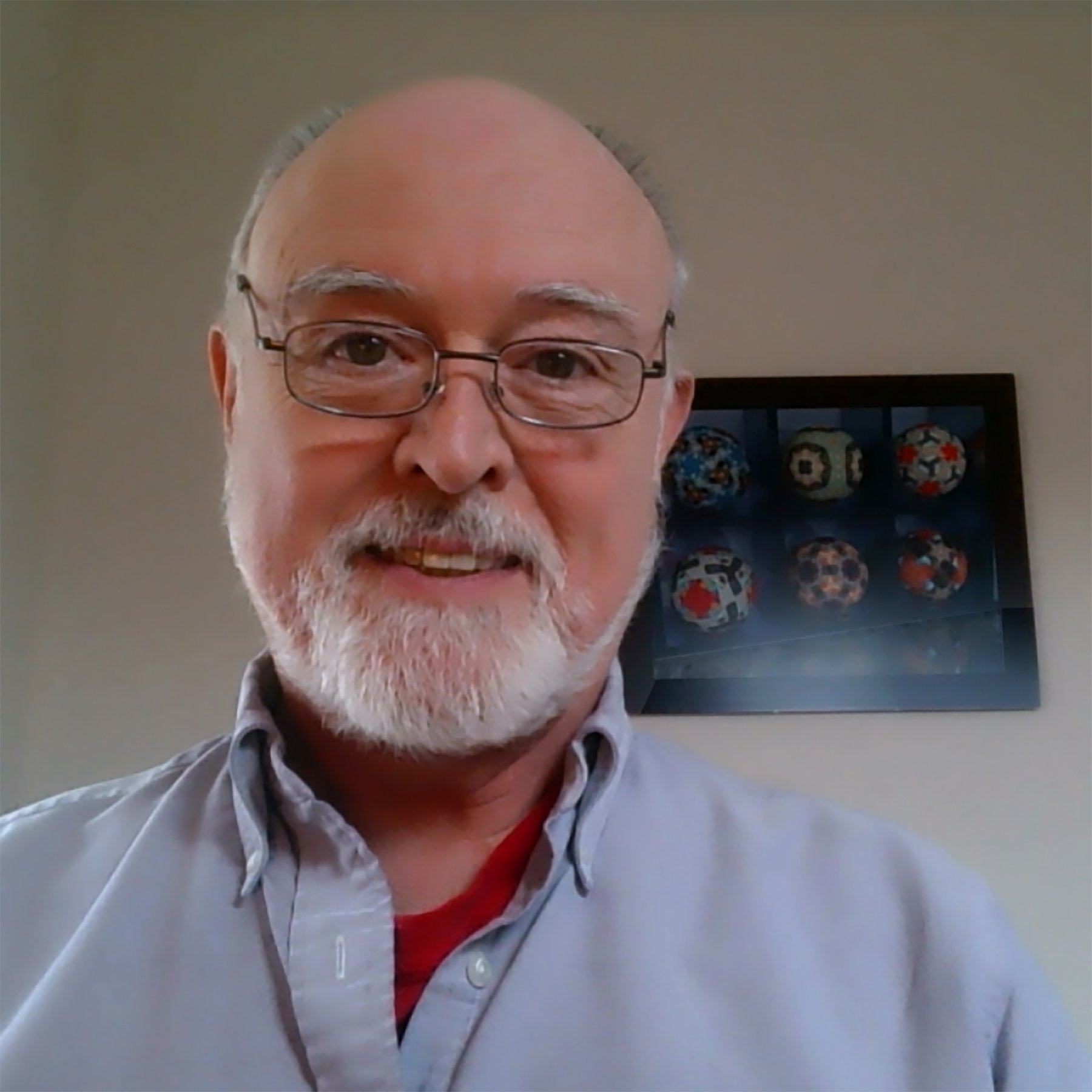
Frank Farris, Santa Clara University
-
Frank Farris has taught at Santa Clara University since 1984. He served as Editor of Mathematics Magazine from 2001–2005, and again in 2009. A frequent contributor to exhibitions of mathematical art, he uses knowledge of mathematics to create digital images that inspire and delight. His book, Creating Symmetry, the Artful Mathematics of Walllpaper Patterns, was published by Princeton University Press in 2015.
-
Abstract: In 1996, I published a paper, “Wheels on wheels on wheels, surprising symmetry,” in Mathematics Magazine. I expected it to be the final word on symmetry in curves made by superpositions of circular motions; the first image shows an example. In 2024, Taiwanese electrical engineers Kuo-Wei Chang and Soo-Chang Pei sent me a version of the second image. It screams 5-fold symmetry, but does not obey the conditions I set out in my article. In this talk, I will share the joyful discoveries we made, as we came to understand that this image is best imagined as an immersion of a torus in the plane! Rather than superpositions of circular motions, I will explain how to construct symmetric torus maps that have great potential for future episodes in mathematical art.
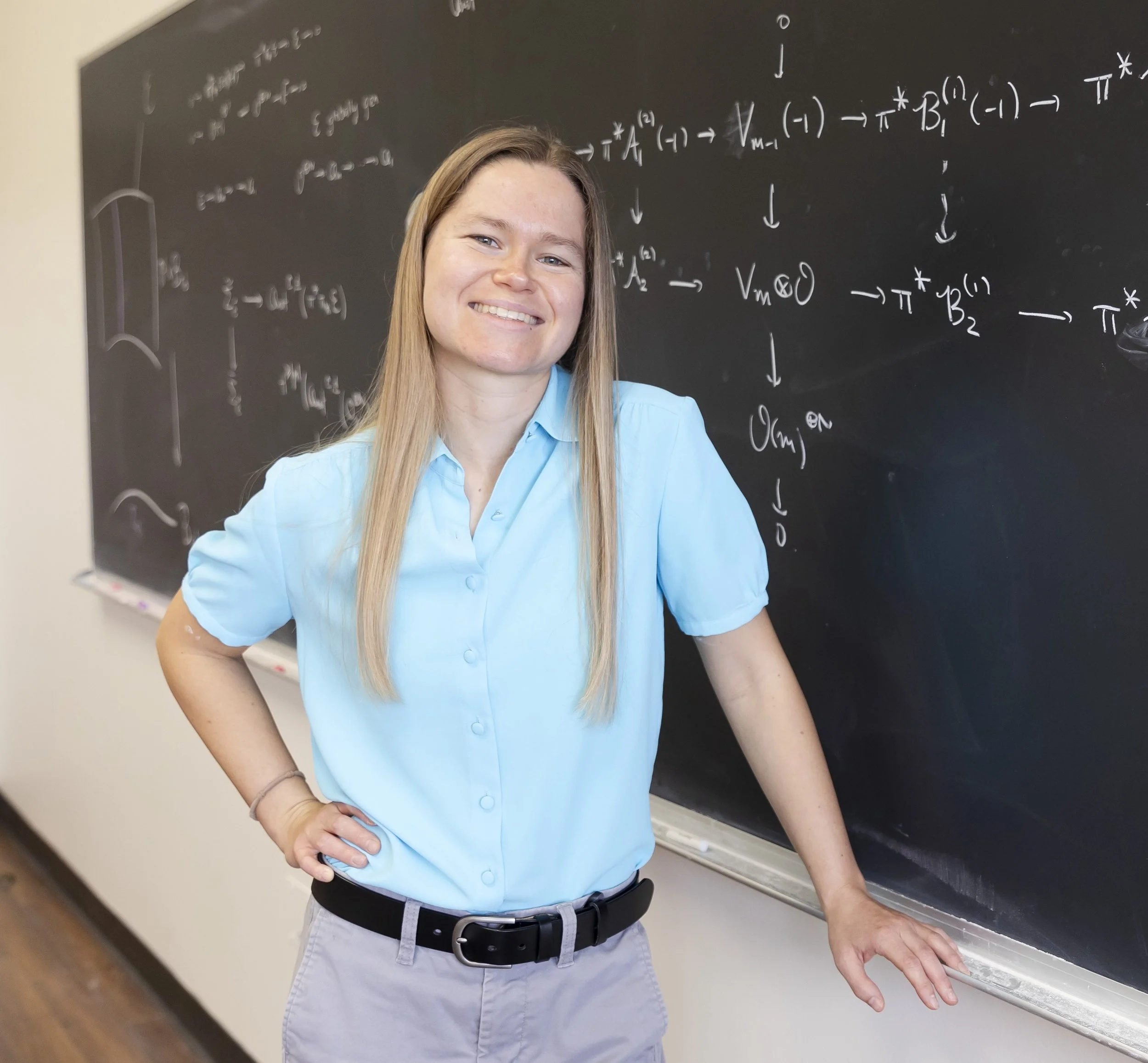
Hannah Larson, UC Berkeley
-
Hannah Kerner Larson is an Assistant Professor of Mathematics at UC Berkeley and a Clay Research Fellow. She received her Ph.D. from Stanford, where she was advised by Ravi Vakil. Her research centers around moduli spaces and algebraic curves.
-
Abstract: A moduli space is a space where each point corresponds to a shape of some kind. It helps us study all shapes of a given kind together. In this talk, I will use the examples of circles and triangles to illustrate some of the important concepts that arise when studying moduli spaces. Time permitting, I'll explain how these themes tie in to my research about the moduli space of Riemann surfaces.
Cindy Wyels, CSU Channel Islands
-
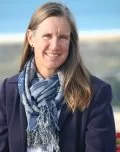
Dr. Cynthia Wyels came to CSU Channel Islands in Fall 2005 after several years at California Lutheran University. At CSUCI, she co-authored three $6 million HSI-STEM grants, directed the campus’ LSAMP program, and served as chair of the Faculty Senate. She’s mentored students through undergraduate research projects through the MAA’s NREUP grants and NSF grants and has offered minicourses for faculty on conducting research with undergraduates. Dr. Wyels received SACNAS’ Distinguished Mentor Award for work mentoring students and faculty from historically underserved groups, the MAA’s Haimo Award for Distinguished University Teaching of Mathematics, and her institution’s UndocuAlly Award. Her mathematical research interests began in combinatorial mathematics and linear algebra. She now applies data analysis tools to study the effectiveness of educational interventions and to collaborate in research on whales.
-
Abstract: Consider the skills and habits of mind developed through studying pure mathematics. These – and some basic statistical techniques – are enough to address some questions of interest given a small data set. With a larger investment of time for individual learning, a healthy dose of humility, and perhaps some collaborators, people whose preparation focused on pure mathematics can produce data-based studies of interest to many audiences. Join me for a story involving a years-long transition, a cast of dozens, some alluring marine megafauna and much serendipity as I argue for the value of all types of research for and by all types of researchers.
Schedule
| Time | Event | Presider |
|---|---|---|
| 8:30am | Registration / Refreshements | |
| 9:30am | Opening Remarks | PJ Jedlovec |
| 9:45am | Bill Dunham, A Tale of Two Series | John Martin |
| 10:35am | Break / Discussion of Section Business (all are welcome) | Will Dana |
| 10:55am | Frank Farris, Phantom Symmetry | Mark Durst |
| 11:45am | Lunch | |
| 12:30pm | Poster Session and Mathematical Art Exhibition | |
| 1:15pm | Teaching Award | Ed Keppelmann |
| 1:35pm | Hannah Larson, Moduli Spaces | Jeffrey Wand |
| 2:25pm | Break | |
| 2:40pm | Cindy Wyels, Data Science for and by Pure Mathematicians | Lei Yue |
| 3:30pm | Break | |
| 3:45pm | Ignite Talks | Ed Keppelmann |
| 4:30pm | Closing Remarks | PJ Jedlovec |
| 4:40pm | END |
Local information
📍Location: Music Recital Hall Center of Performing Arts, Franklin St, Santa Clara
🅿️ Parking (free): North Garage, 1063 Alviso St, Santa Clara
🚌 Public transportation: Santa Clara Transit Center
🛜 WiFi: Use “SCU-Guest”. Visitors from participating institutions can also use “eduroam”. See more information here.
Nearby Hotels
Sonesta Simply Suites Silicon Valley - Santa Clara (0.1 miles from campus)
Sterling Inn (0.6 miles from campus)
Best Western University Inn Santa Clara (1.0 miles from campus)
Residence Inn by Marriott San Jose Airport (3.0 miles from campus)